Paramagnetic Liquid Lens
A study in whether focus can emerge from a field-shaped liquid rather than a moving piece of glass.
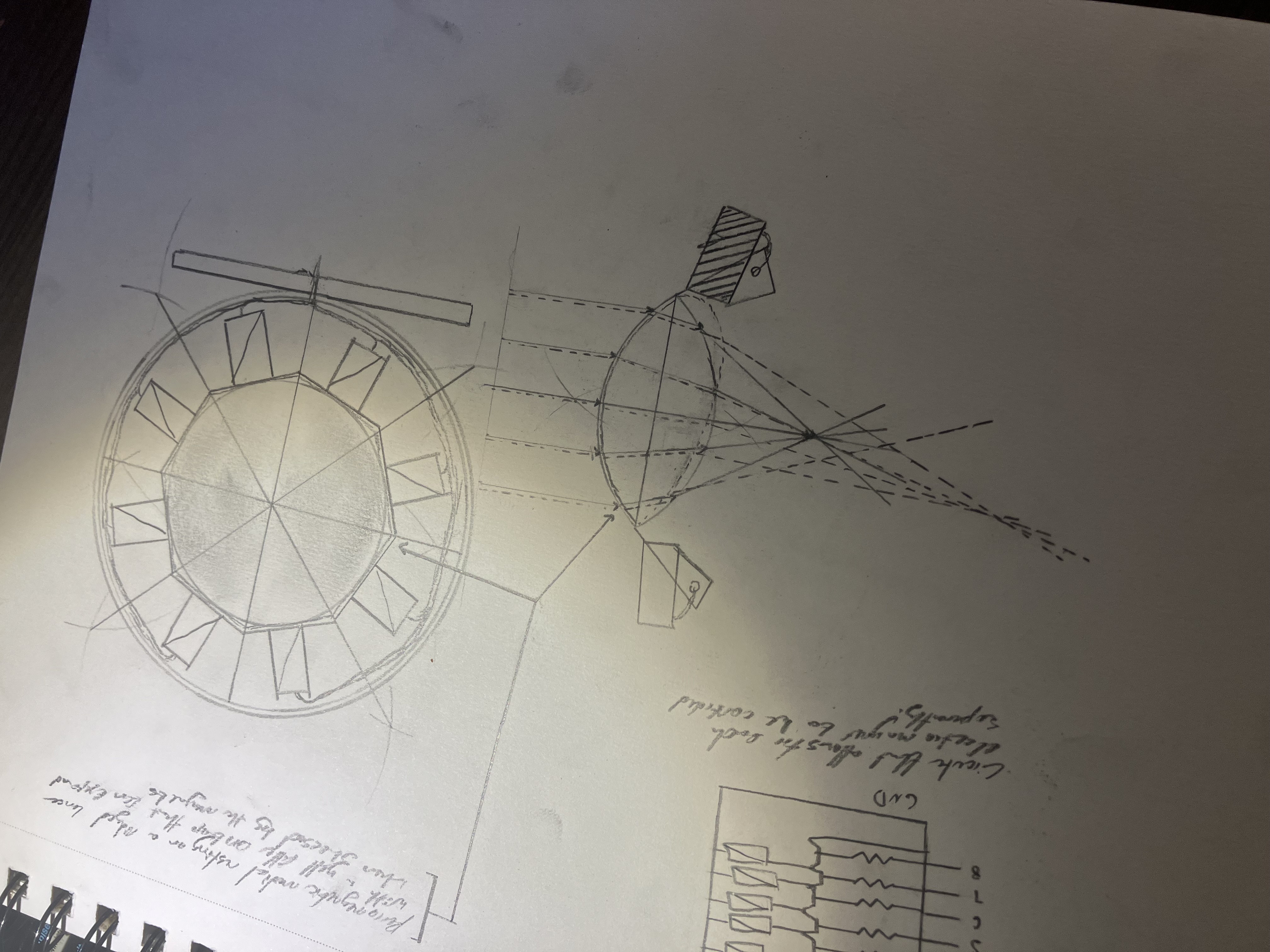
A Paramagnetic Liquid Lens: Shaping Optics with Magnetic Fields
Most optical systems achieve focus through motion. Glass shifts, housings translate, and carefully machined parts do the quiet work of forcing light into clarity. It is an effective tradition, but also a rigid one: every adjustment depends on mechanical movement, and with movement come inertia, wear, complexity, and hard limits on how smoothly a system can respond.
This project began with a simpler and more curious idea: rather than move a lens, reshape one. I am exploring a paramagnetic liquid lens in which the curvature of a liquid interface, and therefore the focal length itself, is controlled by external magnetic field gradients. The appeal is not only technical. There is something deeply compelling about an optical element that can be persuaded rather than mechanically forced into a new shape.
The Core Idea
Paramagnetic liquids are weakly attracted to magnetic fields. Unlike ferromagnetic materials, they do not retain magnetization once the field is removed, making them stable, reversible, and well-suited for controlled actuation.
When a paramagnetic liquid is placed in a container and exposed to a non-uniform magnetic field, it experiences a body force proportional to the gradient of the magnetic field strength. This force redistributes the liquid, deforming its free surface. Because optical refraction depends on surface curvature, reshaping the liquid surface reshapes the lens.
Magnetic field to liquid surface deformation to variable focal length. No moving solid optics are required.
Why a Liquid Lens?
Liquid lenses are not new. Electrowetting lenses are already used in compact cameras and medical devices. However, magnetic actuation offers several distinct advantages:
- Contactless control: No electrodes or mechanical actuators interact directly with the optical surface.
- Smooth, continuous deformation: Lens curvature changes continuously rather than in discrete steps.
- Fast response: The dominant limits are fluid dynamics rather than motor inertia.
- Scalability: The same principle applies from millimeter-scale optics to much larger apertures.
Paramagnetic liquids, in particular, offer a compelling balance: strong enough magnetic response to be useful, without the instability, hysteresis, or optical opacity associated with ferrofluids.
The Physics (Briefly)
The magnetic force density acting on a paramagnetic liquid can be expressed (in simplified form) as being proportional to:
where χ is the magnetic susceptibility of the liquid and B is the magnetic field strength. This magnetic force competes with surface tension, gravity, and container geometry. The equilibrium surface shape, and thus the optical behavior of the lens, emerges from the balance of these effects.
Back-of-Envelope Magnetic Force
Assume the liquid sits in a spherical volume and four identical magnetic points are equally spaced around it. The net force comes from the gradient of the field energy, and the contributions from each point add.
If you want the field to provide a target force (for example, a fraction of the sphere's weight), the required field gradient is:
For equal concentration and temperature, paramagnetic susceptibility scales with the square of the effective magnetic moment. Using spin-only moments:
This means, for the same geometry and target force, a gadolinium nitrate solution would need roughly 0.56 times the ∇(B2) requirement of a manganese chloride solution. The animation below visualizes the setup and the scaling.
Material Exploration: From Manganese to Gadolinium
Initial Experiments: Manganese Chloride
The project began with aqueous manganese chloride (MnCl2) solutions. Manganese(II) ions are paramagnetic, inexpensive, and easy to work with, making MnCl2 a natural starting point for early experimentation. These solutions were used to validate the basic concept: that magnetic field gradients could produce measurable and repeatable surface deformation.
Using manganese chloride allowed for rapid iteration on chamber geometry, magnetic field placement, and stability limits imposed by surface tension and gravity. However, these experiments also revealed limitations: the magnetic susceptibility of Mn2+ is relatively weak, significant deformation required stronger fields or higher concentrations, and optical clarity degraded before large curvature changes could be achieved.
Final Working Fluid: Gadolinium Nitrate
The final working fluid for this project is aqueous gadolinium nitrate. Gadolinium(III) has one of the strongest paramagnetic responses of any stable ion, making it especially well-suited for magnetic actuation at practical field strengths. Switching to gadolinium nitrate dramatically increased the system's responsiveness to magnetic field gradients.
Compared to manganese chloride, gadolinium nitrate enabled greater surface deformation at lower field strengths, improved tuning resolution, and cleaner separation between magnetic control and optical quality. This shift allowed the lens behavior to be governed primarily by magnetic forces rather than by pushing concentration or field strength to extremes.
Why Not Ferrofluids?
Ferrofluids were deliberately avoided. Although they respond strongly to magnetic fields, ferrofluids introduce significant light scattering and opacity, particle aggregation and surface instabilities, and hysteresis due to remanent magnetization. Paramagnetic salt solutions, by contrast, offer smooth, reversible, and predictable deformation, which is essential for controlled optical systems.
System Behavior and Control
In operation, the system behaves as a continuous analog actuator. Increasing the magnetic field gradient increases surface curvature, changing field geometry reshapes the lens profile, and removing the field allows the surface to relax back toward equilibrium. There is no discrete "focus position." The lens transitions smoothly across focal lengths.
Challenges and Ongoing Work
While the core concept is simple, the system involves several tightly coupled physical effects: nonlinear fluid dynamics, magnetic field geometry, surface stability and damping, and optical aberrations introduced by non-ideal curvature. Current and future work focuses on modeling the liquid-field interaction computationally, identifying stable operating regimes, quantifying optical performance under dynamic actuation, and exploring closed-loop optical control.
Why This Matters
A magnetically controlled liquid lens offers a fundamentally different way to think about optics: no moving solids, continuous smooth control, compact and mechanically simple systems. Potential applications include adaptive optics, microscopy, robotics, and sensing systems where robustness and tunability matter more than absolute optical perfection.
Closing Thoughts
This project is ultimately about rethinking a basic assumption in optics: that lenses must be rigid objects. By treating the lens as a dynamic physical system shaped by fields rather than by mechanisms, we gain new degrees of freedom, along with new challenges that are worth solving.